
By Marisa Dawson, Courtesy Photos
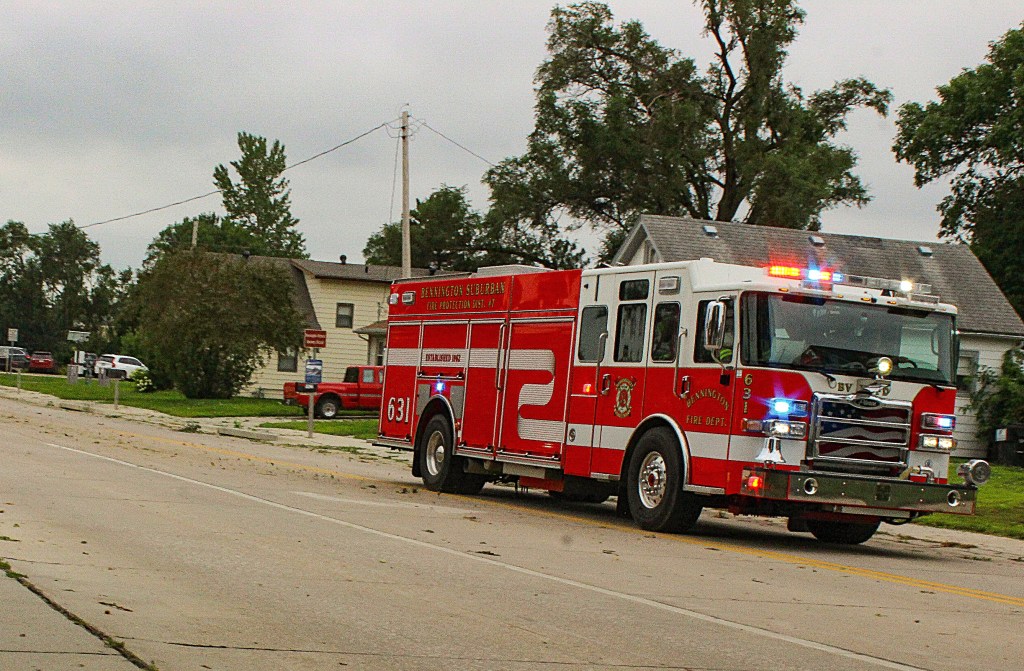
As families prepare for colder weather, holiday gatherings and more time spent indoors, the Bennington Fire Department is reminding community members that preventing a house fire often starts with small, everyday decisions.
Fire Prevention Week, observed October 4-10 this year, provides an opportunity to educate the public about fire hazards and the steps people can take to protect their homes and families. This year’s national theme, “Charge into Fire Safety™: Safe Charging Is a Superpower,” highlights the importance of safely charging devices powered by lithium-ion batteries, according to the National Fire Protection Association (NFPA).
Assistant Chief Chad Nixon and members of the department’s C Shift crew emphasized the importance of recognizing modern fire hazards, maintaining working smoke alarms, practicing an escape plan and knowing what to do when a fire occurs.
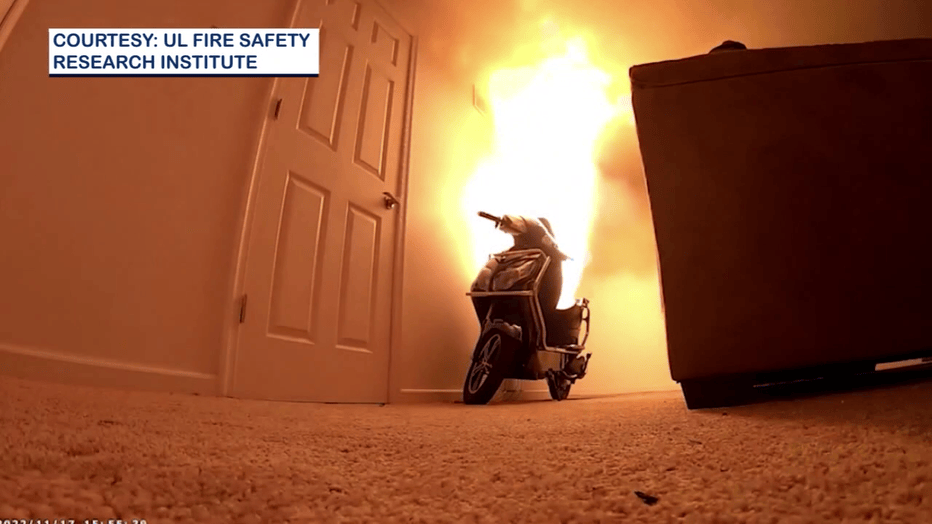
From phones and laptops to electric scooters and other rechargeable devices, lithium-ion batteries have become a regular part of everyday life. However, improper charging, damaged batteries and overheating can create serious fire hazards.
Nixon said rechargeable devices represent a newer concern for firefighters and homeowners.
“The old candles and proper disposal of cigarettes and stuff like that has been around since early on, but now there’s the addition of rechargeable batteries and everything is basically running off electrical, rechargeable battery stuff,” Nixon said.
He added that battery-powered devices are a newer hazard people need to recognize and monitor.
Members of C Shift, including volunteer firefighter/EMT Jess Gerber, firefighter/EMT Colton Mallory, firefighter/paramedic Andrew Hoffman, firefighter/EMT Kaden Ross, and firefighter/paramedic Nate Johnson, also discussed the importance of safe charging habits.
Device owners should use the charger recommended by the device’s manufacturer, avoid leaving devices charging for extended periods and keep charging equipment away from bedding and other flammable materials.
Gerber emphasized the importance of keeping charging devices out of sleeping areas, saying, “Don’t sleep with your phone on your bed.” Devices should be charged on a hard, flat surface rather than a bed or couch.
The U.S. Fire Administration recommends choosing certified products and stopping use of lithium-ion batteries if they show warning signs such as unusual heat, swelling, leaking, discoloration or strange odors. If a battery-powered device catches fire, residents should evacuate and call 911 rather than attempt to fight the battery fire themselves.
Nixon stressed that when a lithium-ion battery enters thermal runaway, the danger can escalate rapidly. “The best thing you can do is evacuate, get out of the house and then call 911,” he said.
The crew also encouraged residents to unplug electric scooters and other rechargeable devices when charging is complete and avoid leaving them charging overnight unattended.
Some of the most effective fire prevention measures do not require purchasing anything new. Nixon encouraged families to make sure smoke alarms work, establish an escape plan and practice fire drills. Every household should identify an outdoor meeting place, such as a mailbox or a neighbor’s home, where family members can gather after escaping.
“Also knowing and having a plan to practice in your fire drills, making sure that your smoke detectors are working, and to practice those skills,” Nixon said. He recommended practicing once or twice a year and establishing a meeting place outside the home so firefighters can confirm that family members have escaped.
“It’s safer to sleep with your bedroom door closed in the event that there’s a fire,” Nixon added. “That helps to keep a safe space for everybody in the residence.”
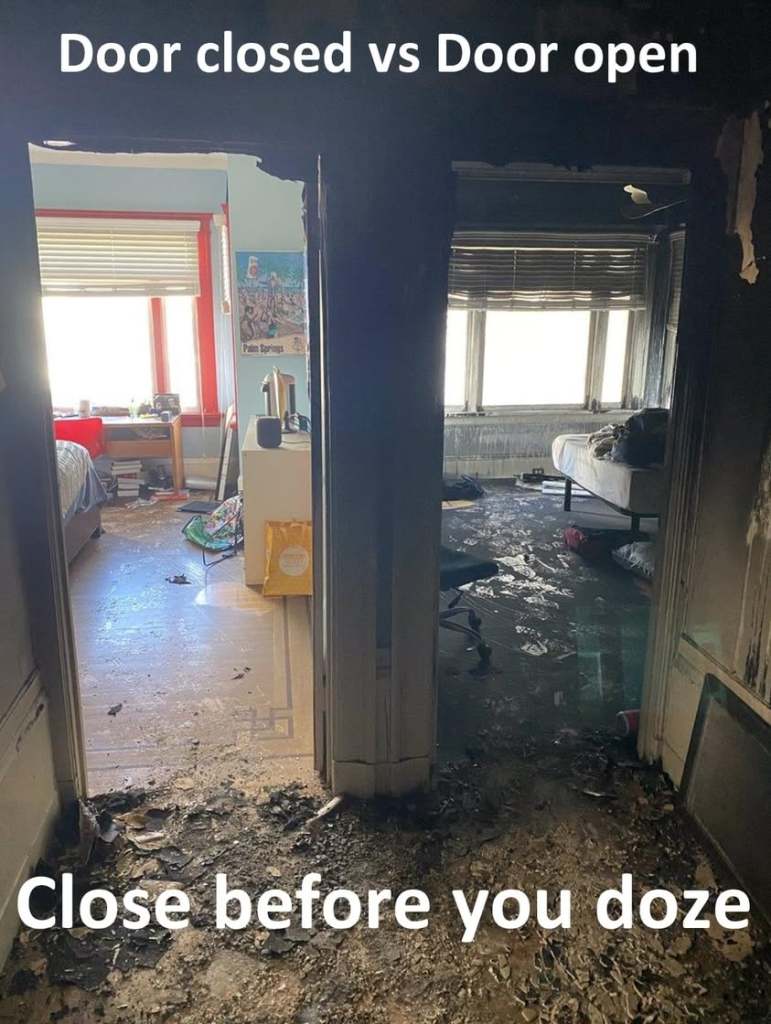
Research conducted by UL Research Institutes’ Fire Safety Research Institute supports that advice. In fire experiments, researchers found that closed-door bedrooms remained significantly cooler than open-door bedrooms as a fire spread. The research measured average temperatures below 100 degrees Fahrenheit in closed-door rooms compared with temperatures exceeding 1,000 degrees in open-door rooms under the tested conditions. A closed door can also help limit the spread of smoke and toxic gases.
Nixon encouraged families to make sure everyone understands how to escape, including children who may need to use a window if a doorway becomes blocked. Families living in two-story homes can consider escape ladders and should practice how to use alternate exits. If someone becomes trapped in a room, he advised keeping the door closed, staying low to the floor and waiting for firefighters to find them.
That message is particularly important when educating children. During school visits and tours of the fire station, firefighters discuss smoke alarms, closed bedroom doors and the importance of not hiding from rescuers. Nixon said firefighters demonstrate their protective equipment so children understand that firefighters may look and sound different when wearing their gear but are there to help.
Gerber reinforced that message with a simple reminder for children: “Don’t be scared of the big people in the big suits.”
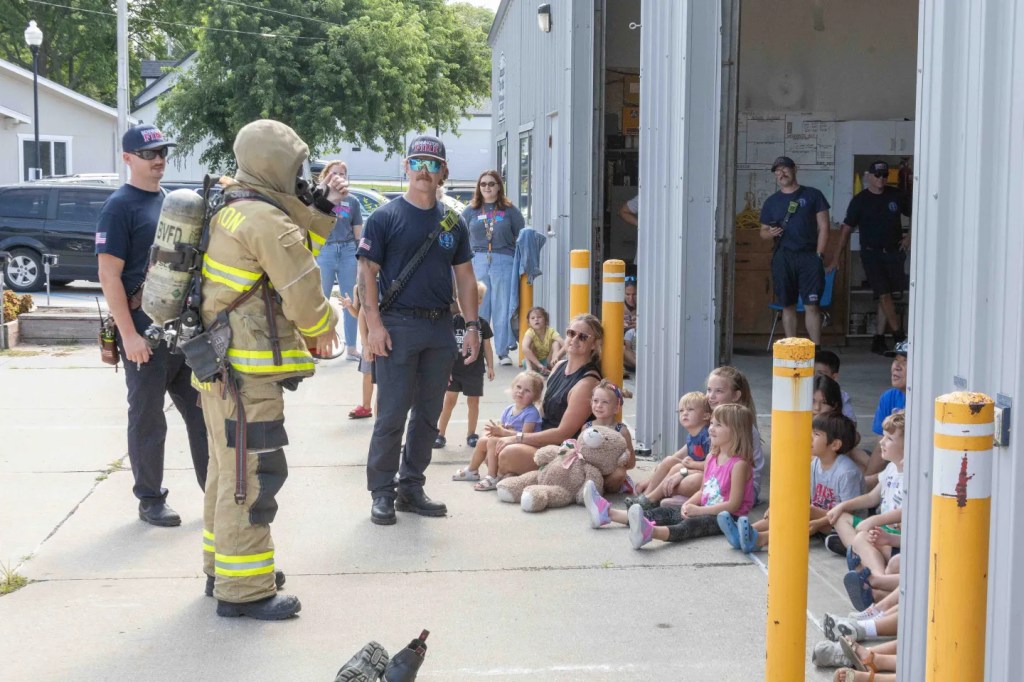
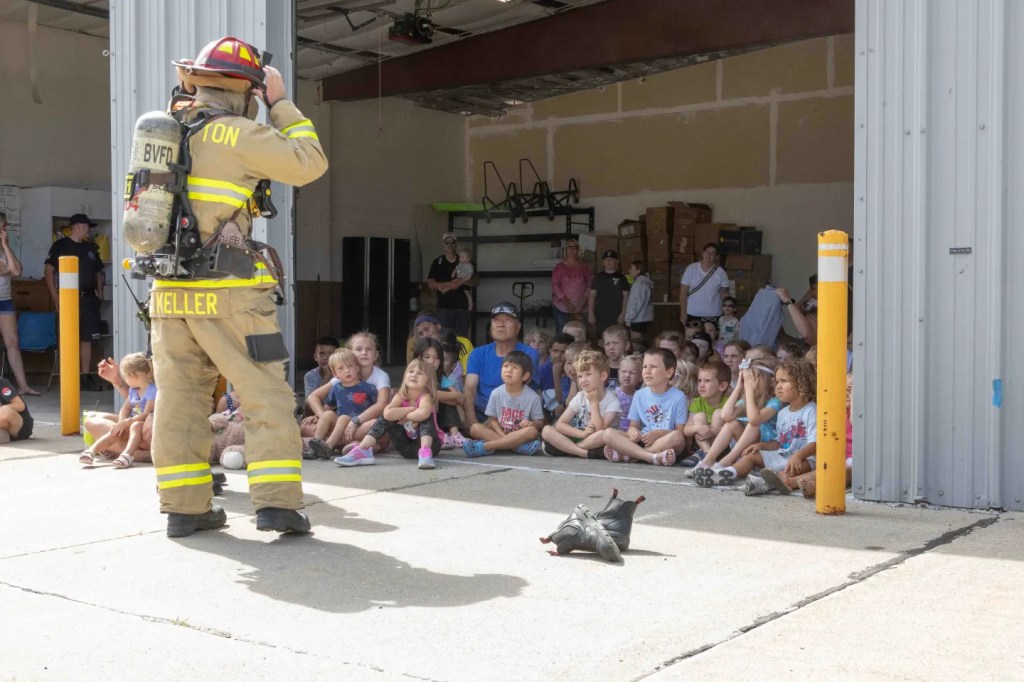
Above: FF/EMT Cole Keller demonstrates how firefighters put on their turnout gear at a library event over the summer.
Nixon also emphasized the importance of making sure children understand that firefighters will come looking for them during an emergency.
“We’re ready and continue to be ready,” Nixon said. “And when we say we’re going to come get you, we’re going to come get you.”
Having the right equipment and knowing how to respond can make a difference when a fire breaks out. Nixon recommended keeping a functioning, multipurpose ABC fire extinguisher in the home. However, residents should understand its limitations and never put themselves at risk trying to extinguish a fire.
Grease fires are a common example of why knowing the proper response matters. Water should never be poured onto burning grease because it can cause the fire to spread. Instead, if a small grease fire remains contained in a pan, residents should turn off the heat if it is safe to do so and cover the pan with a metal lid to smother the flames. They should never move the burning pan. If the fire spreads beyond the pan or cannot be controlled safely, everyone should evacuate and call 911.
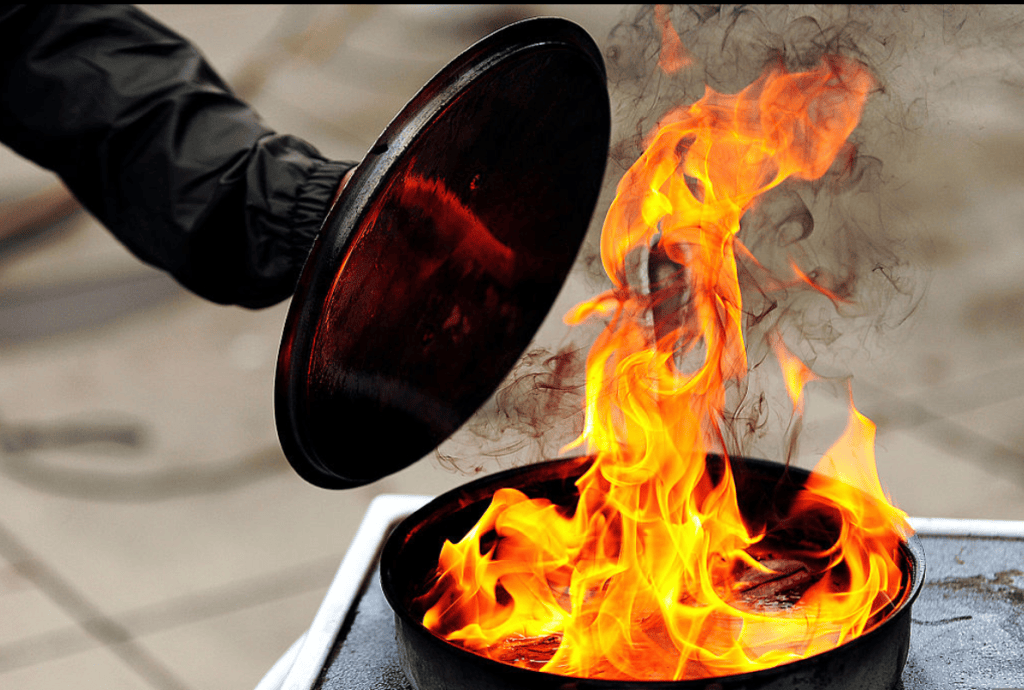
Nixon explained that some cooking fires can be addressed by cutting off their oxygen supply. “It can be as simple as sometimes just putting the lid on the pan, turning the heat source off, and removing it from the heat source,” he said. If the fire spreads beyond the pot or pan, he advised residents to evacuate and call 911.
Lithium-ion battery fires present a different challenge because the batteries can overheat and enter a condition known as thermal runaway, in which heat triggers further reactions inside the battery. Nixon noted that these fires can be particularly difficult even for firefighters to manage.
His advice was straightforward: Get everyone out of the house and call 911 if a battery fire occurs.
Prevention also means paying attention to less obvious hazards around the home. Nixon encouraged residents to dispose of cigarettes and other smoking materials properly, keep flammable materials away from heat sources and store gasoline cans safely in well-ventilated areas.
As temperatures drop, residents will begin using heating equipment more frequently while preparing for Halloween, Thanksgiving and Christmas.
The firefighters encouraged residents to give space heaters plenty of clearance from blankets, furniture and other combustible materials. Space heaters should never be covered or modified, and residents should follow the manufacturer’s safety instructions.
Those with real Christmas trees should keep them watered and away from open flames and other heat sources. Dry trees can ignite quickly, and a fire can spread rapidly through a home.
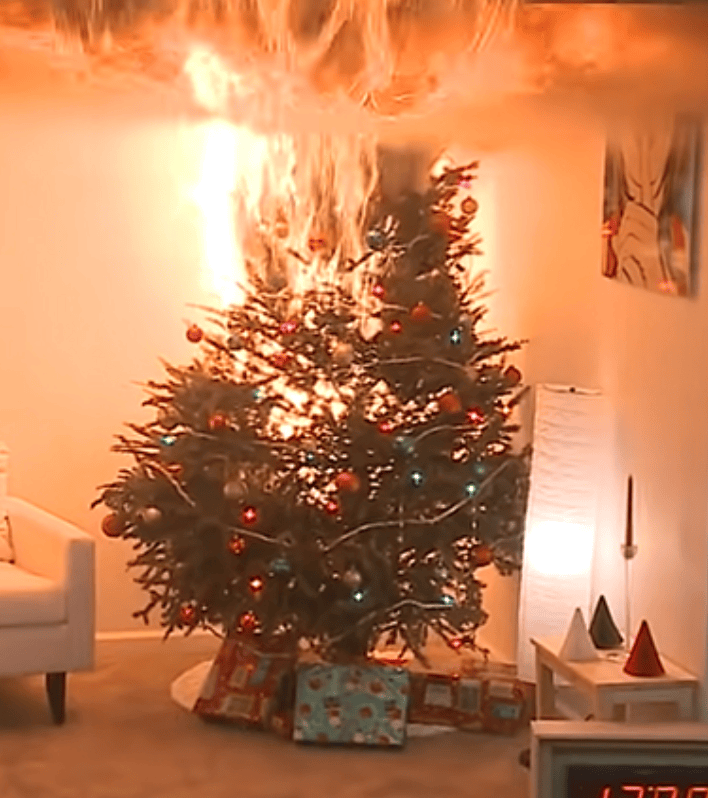
“Keep their Christmas tree watered so it doesn’t get too dry,” Nixon said, and other members of the crew echoed this as well, emphasizing the importance of keeping heat sources away from decorations and other highly flammable materials.
Those planning to deep-fry a turkey should make sure it is completely thawed and place the fryer outdoors, away from the home and garage, on a stable surface. Fryers should never be used indoors or in enclosed spaces.
Fireplaces and heating systems also deserve attention before winter arrives. Chimneys should be cleaned and inspected as needed, while vents for gas fireplaces, furnaces and water heaters should remain clear of obstructions. Snow and other debris like bird nests or leaves can block vents and allow dangerous carbon monoxide to accumulate inside a home.
Nixon stressed the importance of having working smoke alarms and carbon monoxide detectors on every level, particularly in homes with fuel-burning appliances.
Residents can use the upcoming time change as a reminder to check their alarms and replace batteries when needed, following the manufacturer’s instructions. Smoke alarms should be installed on every level of the home and in or near sleeping areas, while carbon monoxide alarm placement should follow applicable safety guidance and local requirements.
The department also encouraged residents to check on older neighbors or relatives who may need help testing alarms or changing batteries.
While the department responds to emergencies throughout the year, Fire Prevention Week offers an opportunity to focus specifically on educating the public.
Mallory described the observance as an opportunity for firefighters to connect with residents through education. “It’s a way for us to reach out to the community in a positive light, because everybody once a year knows about fire prevention month,” he said.
“I think it just goes for the public to become more knowledgeable on the subject. Taking proactive steps to stop fire,” Hoffman added.
Nixon said the department’s school visits and fire station tours help children learn about fire safety while becoming more comfortable around firefighters and emergency equipment.
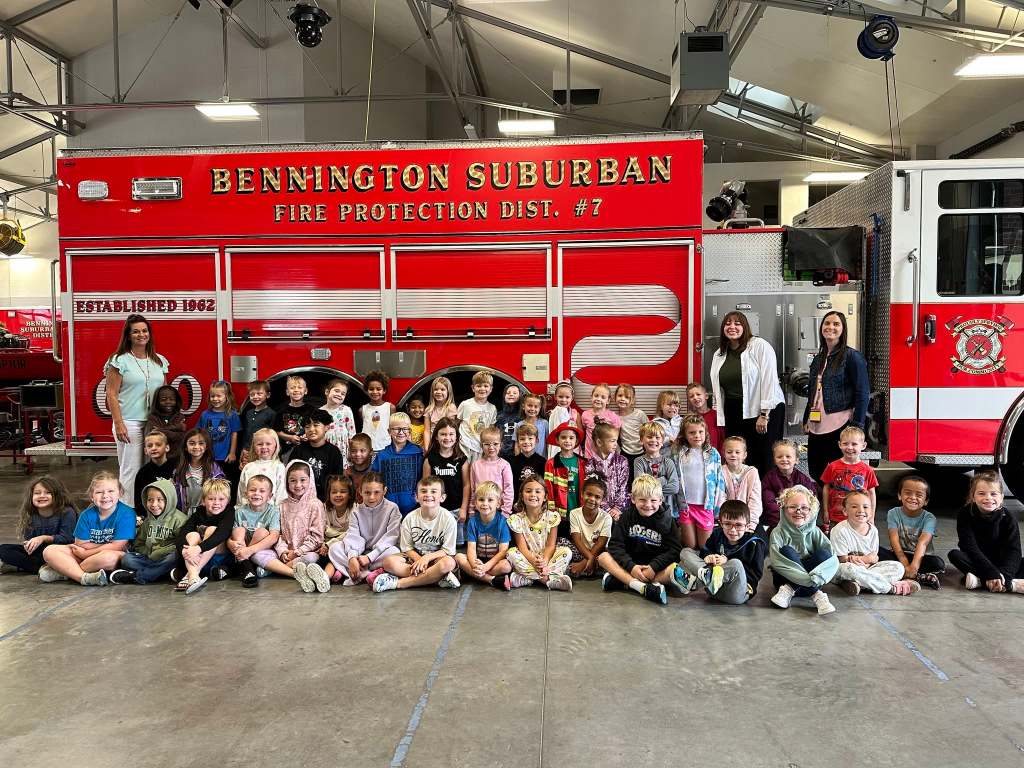
The C Shift crew echoed the importance of reaching community members with practical information they can use at home. Fire prevention is not limited to avoiding dangerous situations; it also means being prepared to respond if something goes wrong.
Nixon encouraged residents to take time to review their household safety measures rather than wait until an emergency occurs.
“It takes a concerted effort,” Nixon said. “You really have to focus on taking that time, whether that’s just 30 minutes to make sure your smoke detectors are working and that you have an exit plan and a meeting place, it takes 30 minutes.”
“And that 30 minutes could be the difference between life and death,” he added.