By Marisa Dawson, Photos courtesy of DCSO
While many traditional crime categories continue to decline across Douglas County and the Omaha metro area, one type of crime is moving in the opposite direction: financial fraud.
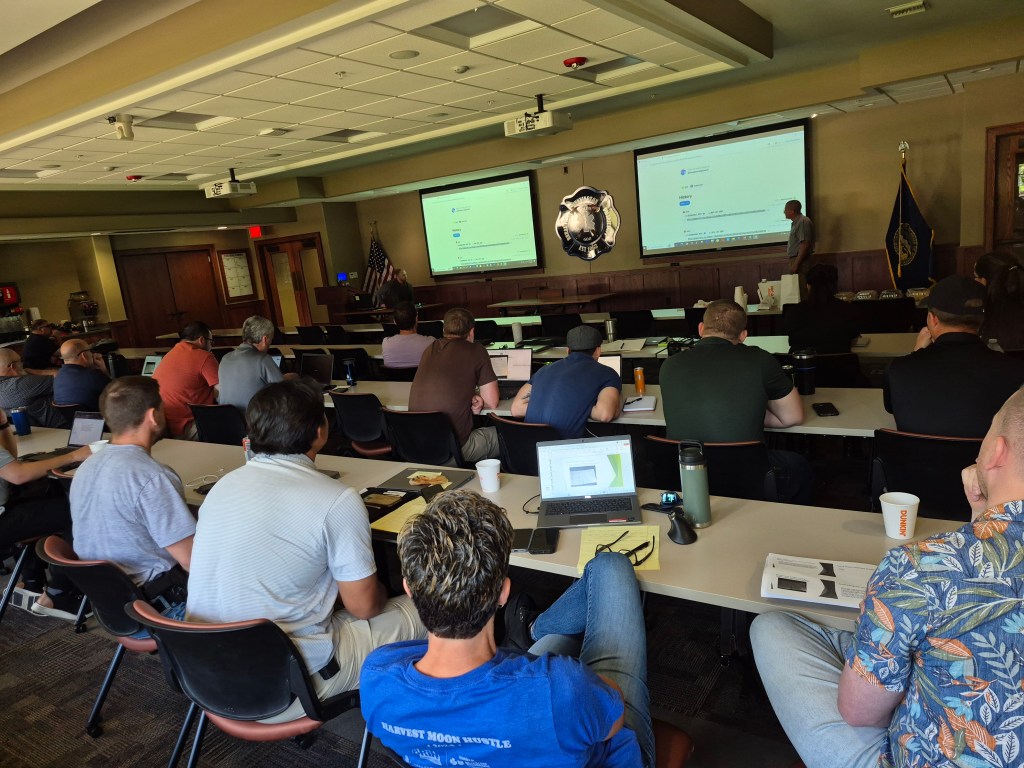
To help law enforcement agencies keep pace with increasingly sophisticated scams, the Douglas County Sheriff’s Office hosted a two-day financial crimes investigation training July 7-8 at Bennington Fire & Rescue. The seminar brought together investigators from 11 agencies across the region to learn investigative strategies and tools for solving complex financial crime cases.
The training was led by Douglas County Sheriff’s Office financial crimes investigators Michael DeChellis and Nicholas Richards, whose work has helped establish the agency as a regional leader in investigating fraud and financial crimes.
According to the investigators, the decision to host the training stemmed from a growing need to combat a crime trend that continues to affect victims throughout the area.
“Over the past few years we have been very fortunate that the hard work of the DCSO, OPD, and other agencies in Douglas County and the greater Omaha area has led to decreasing rates in most major categories of crime,” DeChellis and Richards said. “Financial crime is a significant outlier. We have seen year-over-year increases in both reports and dollar losses.”
They noted that legislative changes approved by the Nebraska Legislature in 2025 have helped reduce losses in cryptocurrency-related cases, but scammers continue to evolve their tactics.
“Fraud and financial crimes can completely ruin a life and often go unsolved due to the increasingly complex and technical nature of the cases,” the investigators said. “We feel strongly that many of these financial crimes are solvable and want to share our subject matter expertise with peer agencies to ensure they have the knowledge and tools to successfully investigate and solve them.”
Throughout the seminar, attendees learned new investigative methods designed to improve their ability to identify, investigate and solve financial crimes.
“The seminar’s primary goals are to ensure attending investigators leave with knowledge of new methods and tools that can assist them in successfully investigating and solving financial crime cases,” they said.
Investigators said scams now account for the majority of financial crime cases they encounter. Those scams range from long-term romance schemes to text messages and phone calls impersonating government agencies or law enforcement.
“Scams are the most prevalent financial cases that we see,” they said. “These can range from romance or relationship based long term scams to jury duty or DMV scams where scammers will send massive amounts of texts or emails trying to get individuals to send them money.”
Technology has dramatically changed both how scammers operate and how investigators respond. Criminals increasingly rely on cryptocurrency, digital payment platforms and mass messaging campaigns to reach victims and quickly move stolen funds.
“As the finance sector changes and technology becomes more prevalent in everyday life these cases also become more sophisticated,” the investigators said. “Scammers are utilizing technology, specifically cryptocurrency to move money quickly and make it difficult to trace.”

At the same time, investigators said technology has become an essential investigative tool.
“Technology is a double edged sword,” they explained. “Technology assists in many ways; it makes it easier to follow the money trail in many complex investigations that involve multiple crypto wallets or bank accounts. Technology also leaves a paper trail through IP addresses, etc.”
Despite those advances, recovering stolen money remains difficult, particularly when scams originate outside the United States.
“Many of these more complex crimes originate overseas,” the investigators said. “Jurisdictional challenges make it difficult to hold scammers accountable and recover stolen funds after it leaves the country, even if accounts are identified and warrants issued for arrests.”
The investigators said scams can affect residents in communities of every size, including Bennington.
“Scams can impact anyone, anywhere, and anytime,” they said. “We receive reports from across the county regularly.”
Among the most common schemes currently circulating are jury duty and Department of Motor Vehicles impersonation scams. Victims typically receive a phone call or text claiming they have missed jury duty, owe unpaid tickets or face an arrest warrant unless they immediately send payment.
The investigators cautioned that legitimate law enforcement agencies will not demand payment through cryptocurrency kiosks, gift cards or other unconventional methods.
Instead, they encourage residents to slow down and recognize the warning signs.
“Awareness is key,” they said. “If it seems too good to be true, it likely is. Be aware of the tactics that scammers use, such as creating urgency, creating pressure, or asking for secrecy.”
Anyone who believes they may be the target of a scam is encouraged to contact the Douglas County Sheriff’s Office Scam Line at 402-444-SCAM (7226) before sending money or sharing personal information.
Beyond the classroom instruction, investigators said bringing agencies together strengthens regional partnerships that can benefit future investigations.
“Often, agencies in the same region see very similar cases and face similar challenges,” they said. “Joint trainings allow investigators to not only learn together but also to share best practices and build regional relationships and compare notes on similar cases.”