By Marisa Dawson, Courtesy photos
Most middle school history projects end with a grade in the teacher’s gradebook.
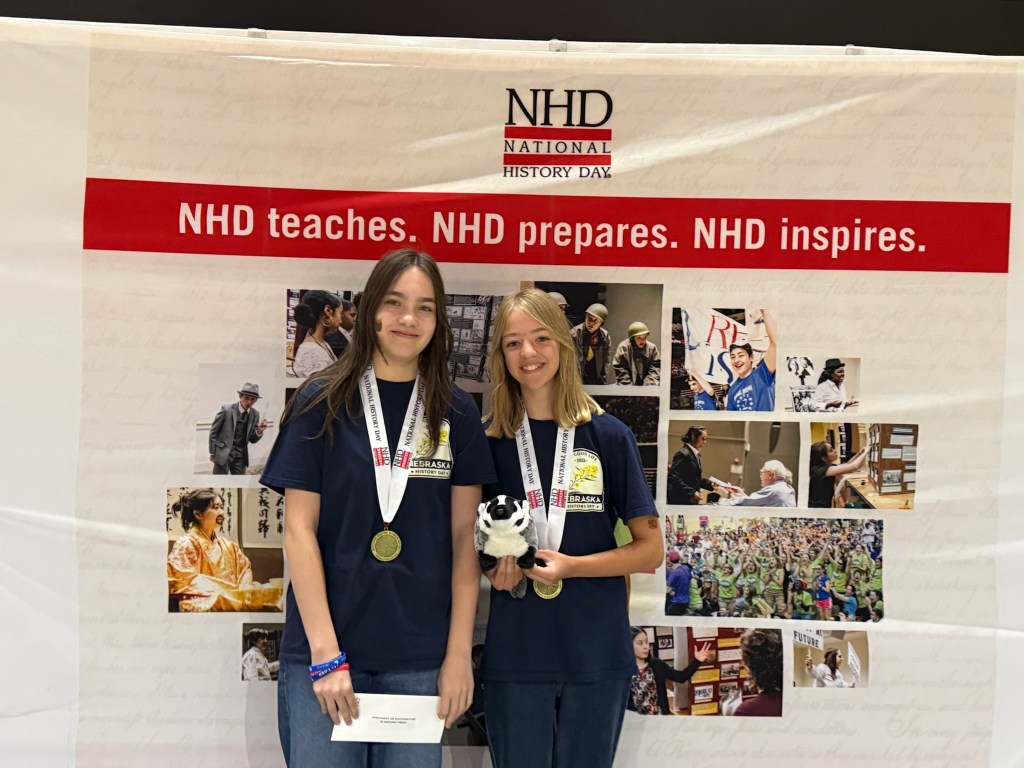
For Bennington Middle School students Payton Combes and Valeriya Bridgeford, theirs will be preserved for generations.
After spending months researching pioneering women explorers and performing their project before judges across Nebraska and the nation, the pair returned home from the National History Day National Contest with an honor few students ever receive. Their project about the Society of Woman Geographers will become part of the organization’s permanent archival resources housed within the Library of Congress, where future researchers will be able to view their work.
The students also captured a national special award, earning the Discovery or Exploration in History Prize at the National History Day National Contest in College Park, Maryland.
For two middle school students, the realization that their work would become part of one of the world’s most significant historical collections was almost impossible to believe.
“I was really surprised because I didn’t think that I would ever be in the Library of Congress,” Combes said. “I thought that was more for people who did something big with history or stuff like that. So it really surprised me that our 10-minute performance for competition was going to become part of the Library of Congress and be remembered forever.”
Bridgeford shared a similar reaction, saying, “It also really surprised me because just looking up and seeing that we are in the Library of Congress, it’s a huge honor to be in it because I didn’t see myself as in the Library of Congress, so I was just, ‘Wow.’”
The students’ project, “Making Their Mark: The Women Who Mapped the World,” explored the history of the Society of Woman Geographers, an organization founded in 1925 after women explorers were routinely excluded from many professional geographic societies despite making significant contributions around the world. According to National History Day, the annual program engages more than half a million students nationwide in historical research, interpretation and presentation through documentaries, exhibits, performances, papers and websites.
Combes said the women featured in their project continue to inspire people today.
“I think that the stories of these women still matter today because they built this whole society without any help from men,” she said. “They built this whole club in this field that people had always said wasn’t really for women. So I think it matters because it can still inspire women today. Even if it isn’t just for geography or exploration, it can inspire women to do similar things in different fields.”
Bridgeford agreed.
“They basically pushed out people who were against women being explorers,” she said. “They’re like, ‘We can do this by ourselves. We don’t need any help from men.’ It’s just really important because it can show what women can actually do.”
Long before they stood on a national stage, the students discovered that historical research often means chasing dead ends before finding new paths.
One of those moments came while researching Society founder Blair Niles.
“We actually stumbled upon one of the sites and it explained to us that there were no records on Blair Niles,” Combes said. “So it completely changed how we had to research because then we had to go into other files that also included Blair Niles but weren’t about Blair Niles herself.”
Bridgeford said they also had to rethink how they organized their story as they learned more about the Society itself.
“We learned some things about the Society, like the qualifications you had to have to join the Society,” she said. “That kind of changed the direction of where we had to go because we had to find ways to incorporate that into our performance.”
The amount of information quickly became overwhelming. After contacting the Society of Woman Geographers for additional historical resources, the students received copies of Blair Niles’ travel writings- 18 books in all.
“When we were looking through the books, it was very challenging because it was back in the Great Depression,” Combes said. “It was kind of hard to follow along and stay on track.”
Bridgeford said one of the biggest challenges was deciding what to leave out. “Out of all these books, we had to decide what we think is the most important,” she said. “What parts can we incorporate, and what pieces do we have to cut because they don’t stand out to us as much?”
Advancing to the National History Day competition meant competing against students from across the country.
“It was absolutely nerve-wracking for me,” Combes said. “Normally I’m so competitive, and I’m like, ‘What if they’ll be better than us?’ But normally I push those thoughts aside and I think about ourselves, what we can do best and what our qualities are.”
Bridgeford admitted she constantly worried about making mistakes. “It was also really nerve-wracking for me because I didn’t know how anything was going to play out,” she said. “I didn’t know if we were going to make it. I always worry that if I make one little mistake, that’s going to be what gets us knocked down.”
Then came the awards ceremony. For both students, hearing “Bennington, Nebraska” announced before a national audience was the moment everything became real.
“I was just very happy to represent Nebraska because it’s showing that we’re doing what we love and we’re getting an award for doing it,” Combes said.
Bridgeford said that moment remains unforgettable. “I think probably when we won the special award because they called out, ‘Bennington, Nebraska,’ and every competitor there hears that. We did this for Nebraska and represented them live on a stage for a ton of people.”
The students’ relationship with the Society of Woman Geographers extended well beyond their research and competition.
After qualifying for Nationals, Bridgeford’s mother reached out to the organization to see whether they would be interested in meeting while the students were in the Washington, D.C., area.
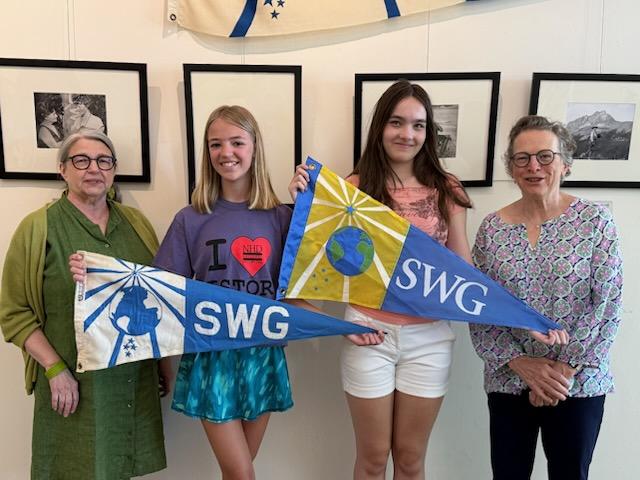
“They replied back and were like, ‘Yeah, we’d love to meet them,’” Bridgeford said. “My brain was like, ‘Oh my gosh, this is actually going to happen. I’m actually going to meet the inspiration for our project, or part of the inspiration.’”
Combes said the Society had already seen a recording of their state-winning performance.
“We sent them a video of our play from state, and they’re like… ‘This is so amazing. Can we put it up on our website?’” she recalled. Later, the organization asked to meet them and professionally film their project while asking questions. “I was really excited because it’s so rare to have an opportunity like this,” Combes added.
During their visit, the students discussed why they chose the Society as the focus of their project and why its history remains important today. Their professionally recorded documentary and interviews will now become part of the Society’s permanent archival collection housed within the Library of Congress.
“It means that people are actually taking their time and looking at what we’ve done and what we’ve made, and to show others,” Combes said.
Bridgeford hopes people continue discovering their work decades from now. “It means that people in the future can be like, ‘Oh, this is cool. They did this for competition that made it this far and brought so many opportunities with this play.’”
Asked what she hopes someone finds if they discover the documentary a century from now, Combes pointed to the message at the heart of the project. “The message that women aren’t guests in the field of exploration and geography,” she said. “They’re actually leaders who did something to prove that they can do it.”
The experience changed both students in ways that extend beyond research and competition.
Bridgeford said she learned perseverance. “Just to not give up and keep going, that we can do stuff like what the Society of Woman Geographers did.”
Combes said National History Day helped her conquer a lifelong fear. “For me, it’s speaking out to a crowd because normally I was really afraid of speaking out… Until I joined National History Day and learned that I had to face my fear and actually speak out.”
She now hopes to pursue history as a career. “I really love history, and my mom had a degree in history too, so I’m going to follow that.”
Teacher & National History Day Coordinator Amy Diegel has guided students through National History Day for several years, but this year’s experience was unlike any before.
“I had to kind of blink because I was like, ‘Wait, that’s us,’” she said after hearing Bennington announced during the awards ceremony.
Ironically, the students had not even nominated themselves for the Discovery or Exploration in History Prize.
“When we do the registration for National History Day, we have to self-nominate, but we’re only allowed to self-nominate for a limited number,” Diegel explained. “We felt that self-nominating for the Women’s History Award would be a little bit more significant because it was a society founded by women for women in the face of misogyny.”
Reading the judges’ comments afterward helped everything click.
“When we went back through afterward, we got to read the judges’ comments on why they chose this project for that particular award,” she said. “The way they framed it was like, ‘Oh, okay, that one makes sense too.’”
Although Diegel introduced National History Day in Bennington after teaching previously in Hawaii, where only elementary students participated, this marks the first time one of her teams has earned a national special award.
“I think we’re kind of on a streak,” she said with a laugh. “I’m looking forward to hearing ‘Bennington, Nebraska’ a few more times at nationals in the coming years.”
For Diegel, however, the most meaningful part of National History Day isn’t the awards.
“I think one thing about National History Day that kind of gets me is watching them be proud of themselves,” she said. “That moment when that part changes, whether it’s during a performance run, during after-school hours, or if it’s at a competition, you can tell when they feel they’ve nailed it. They just glow.”
For two Bennington students whose work now has a permanent place in one of America’s most important historical archives, that glow has become part of history itself.