
By Marisa Dawson, Courtesy Photos
Sixty years ago, a small group of Bennington volunteers saw a growing need and decided their community deserved faster emergency medical care.
Armed with little more than determination, basic first aid training and a refurbished station wagon, they built what would become Bennington’s medical rescue squad. This laid the foundation for an organization that continues saving lives today.
That milestone was celebrated recently during a 60th anniversary dinner at Farmer Brown’s in Waterloo, where several of the squad’s original members reunited with their families, current firefighters, paramedics and department leadership to reflect on the rescue squad’s beginnings and the remarkable evolution of emergency medical services in Bennington.
Among those in attendance was Larry Arp, one of the original seven members of the rescue squad, whose nearly six decades of service helped shape not only Bennington Fire & Rescue, but emergency medical care across Nebraska.
“It was really great,” Arp said of the reunion. “There were some stories that were told… it was really great for the five of us that were there.”
When the rescue squad officially entered service on January 1, 1966, Bennington looked much different than it does today.
The town had only about 450 residents, surrounded primarily by farms, and neighboring communities like Elkhorn, Waterloo, Valley, Kennard and Arlington had no rescue squads of their own.
“We serviced from 108th on the east… all the way to Dodge County, well, just about Dodge County, which was the Platte River,” Arp recalled. “There was no squad in Elkhorn, Waterloo, Valley, Kennard or Arlington.”
The department’s first ambulance wasn’t purpose-built. Volunteers purchased a used station wagon from Ralston VFD and completely rebuilt it themselves. With $600 spent on the vehicle and $400 spent on renovations, the entire project cost an initial $1,000.
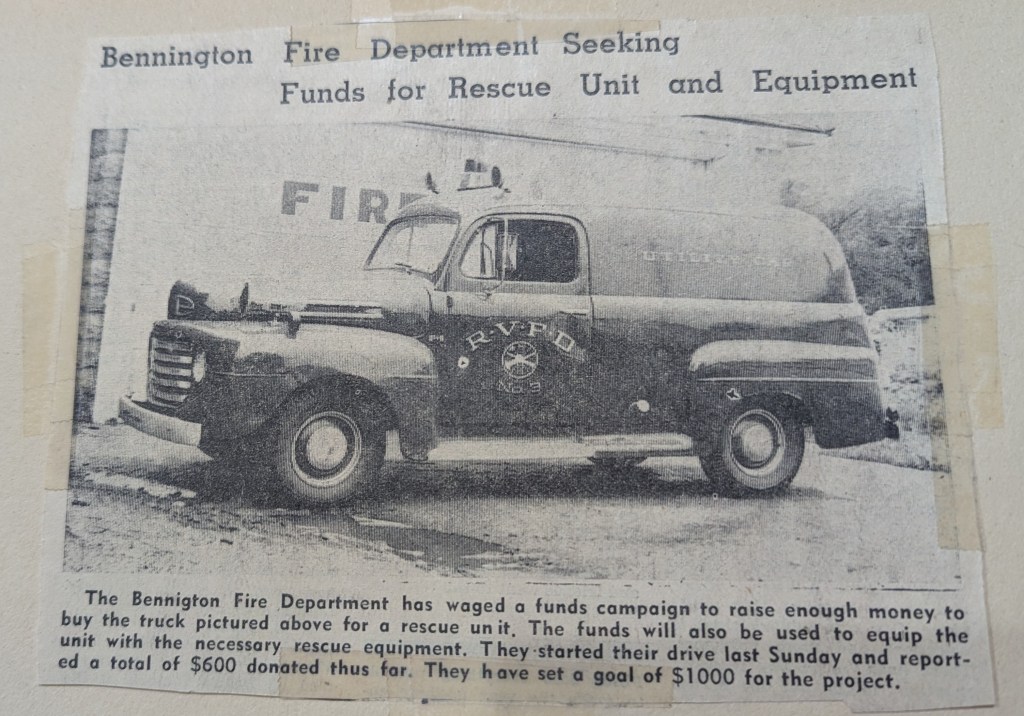
“New brakes, tires, complete refurbish,” Arp said. “January 1st, we went into service.”
Like nearly everything else in those early years, the project depended entirely on volunteers. Members performed the mechanical work themselves. The auxiliary washed and ironed uniforms and linens. Volunteers went door-to-door collecting donations to purchase equipment.
“We had to go door to door and get money,” Arp said. “We did our own repairs ourselves.”
One resident wasn’t convinced the new rescue squad was necessary, believing nearby Irvington could handle emergencies.
“The first call we ever made was for his wife,” Arp said with a laugh.
At the time, Bennington’s fire department responded to only a handful of fires each year.
“Our fire department, we would only make maybe three or four fire calls a year,” Arp said.
The rescue squad (pictured below) quickly proved its value. During its first two years alone, the original squad responded to 145 rescue calls and 68 fires, transported 166 patients, handled eight deceased patients and logged more than 8,000 miles across its expansive coverage area.

Front Row: John Voss, Terry Loptin, Larry Arp, Marion Charron, Rollie Wiedrick
Not Shown: Jerry Roe, Ellis Rhoades, Bernie Schambra
“Now that doesn’t sound like much, but back then that was a lot,” Arp said.
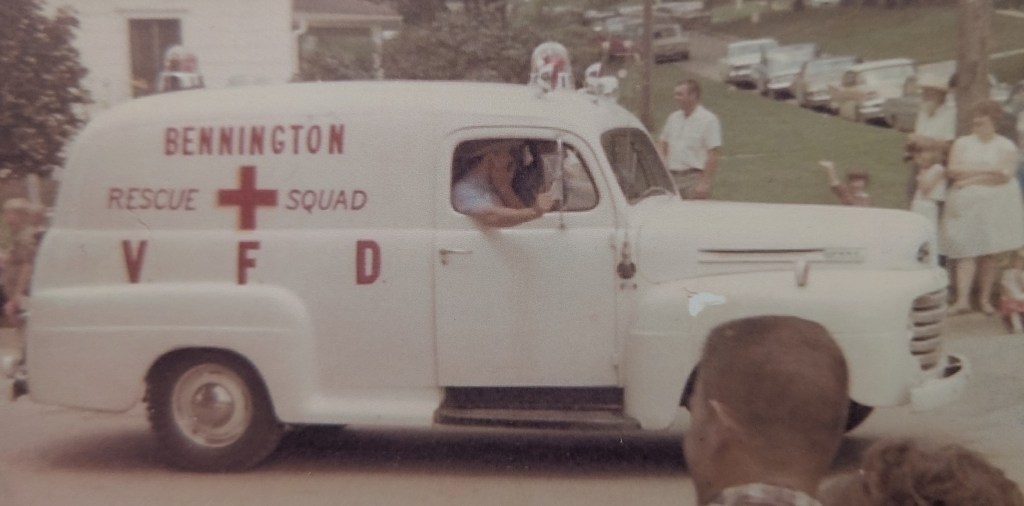
The calls often stretched far beyond Bennington, serving communities throughout western Douglas County before neighboring departments established rescue services of their own. Eventually, demand became so great that volunteers built a larger ambulance out of a bread truck (pictured below) capable of transporting multiple patients simultaneously.
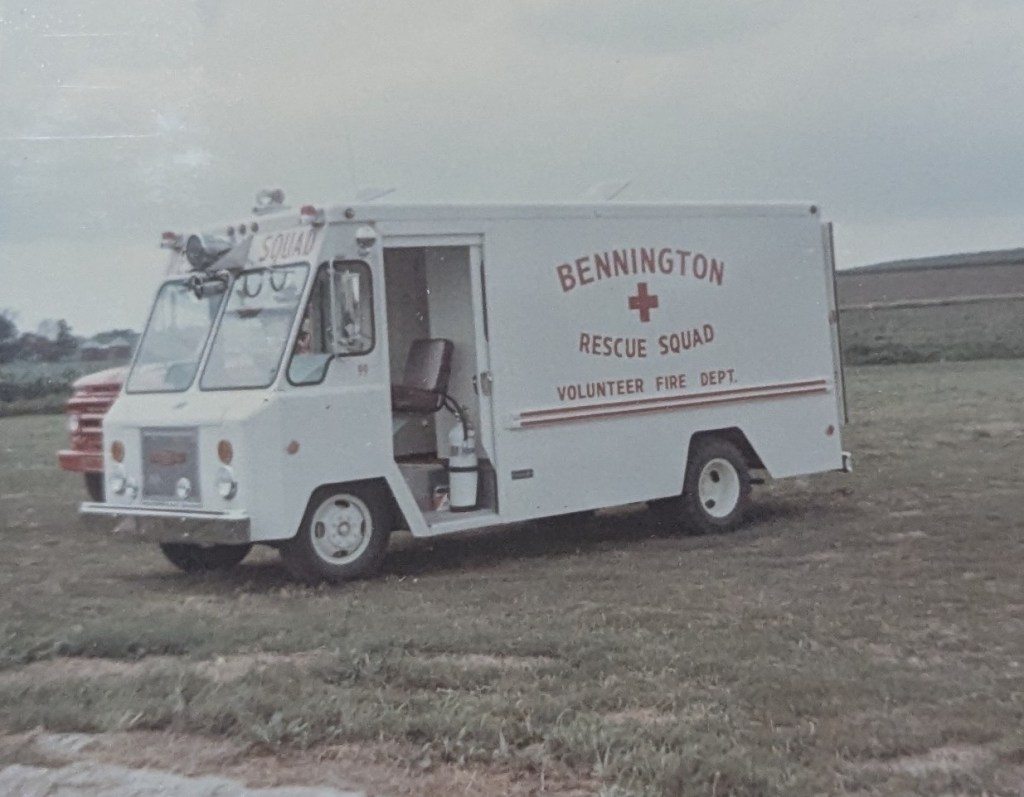
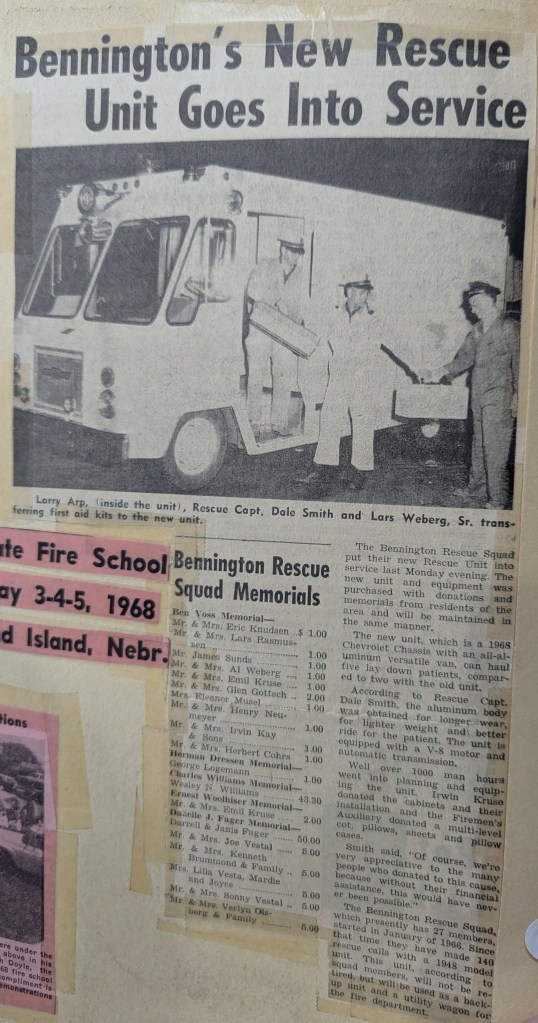
“We could carry five stretcher patients,” Arp said. “We took in 11 one time out of just one squad.”
The original station wagon remained in service as a utility vehicle before eventually being sold in 1969.
As emergency medicine evolved, Bennington consistently stayed ahead of the curve.
Arp said the department was among the first in the region to establish EMTs, later one of the first to transition to paramedics, and one of the earliest agencies transmitting electrocardiograms directly from patients’ homes to hospitals.
“We had the first EMTs in the area. We had the first paramedics in the area. We had the first transmissions of EKGs in your house to the hospital.”
Those advancements didn’t happen by accident. Arp served on state committees that helped develop Nebraska’s EMT standards, replacing inconsistent practices with statewide requirements.
“We wrote the law to make the EMTs happen, what you had to have,” he said. “Everybody just hodgepodged what they could put in a unit… and we set it down as a specific thing you had to have.”
He also served on protocol committees that gradually expanded what paramedics could do independently in the field.
“We just kept scratching that off and saying, ‘Do it, do it, do it,’” Arp said. “Now you don’t have to call in with anything. You just tell them what you did.”
The department also embraced new technology as it became available: from advanced cardiac monitoring decades ago to today’s mechanical CPR devices (LUCAS device) and more to come.
“They’re still keeping it going,” Arp said. “And that makes me proud.”
Many of Bennington’s earliest accomplishments were possible because volunteers donated not only their time responding to emergencies, but also countless hours constructing equipment and facilities. When the department needed a larger station in 1969, volunteers built nearly all of it themselves.
“We had the building erected. They poured the foundation and erected the building, and we did everything else,” Arp said. “We did all the cement work inside. We did all the electrical inside, and we helped with the plumbing.”
The entire building cost just $35,000.

Even after it opened, resources remained limited. Before the new station was built, the ambulance sat in an unheated shed across the street, requiring volunteers to keep a heater running inside so equipment and liquids wouldn’t freeze during winter.
“There was some pretty crude stuff way back when,” Arp said.
Although Arp remembers countless emergency calls (including the one below) over nearly six decades—including fatal crashes, devastating fires and traumatic accidents—he also remembers the lives saved.
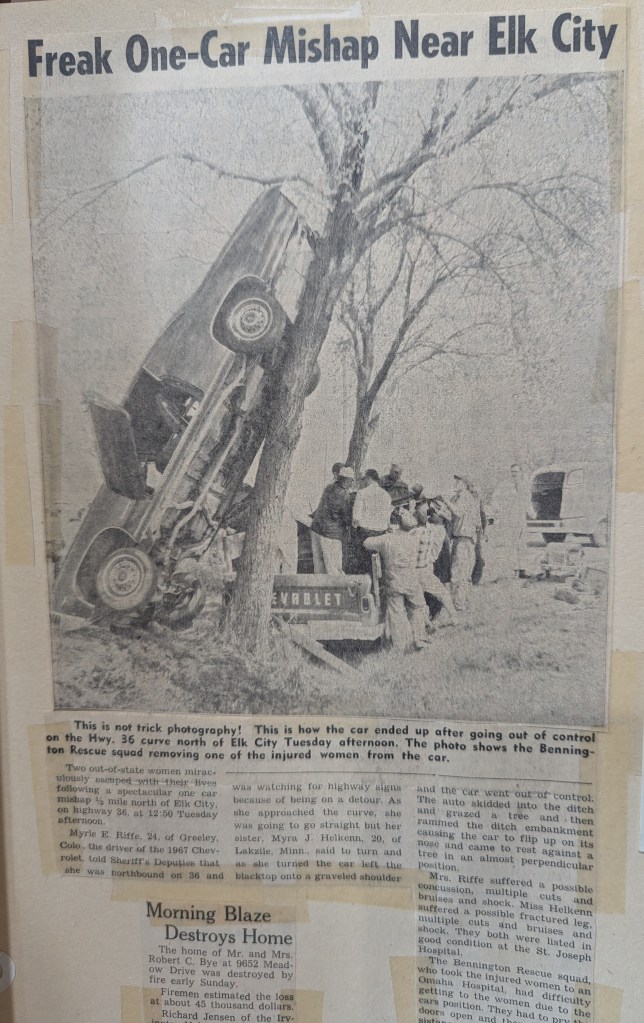
His final paramedic call before stepping back from advanced service remains especially meaningful.
“My very last paramedic call that I made was a life save,” he said. “She came to our banquet the next year and sat at the table.”
He smiled while reflecting on the moment.
“That was quite a way to go out, I guess.”
Over the years, Arp’s wife also became deeply involved with the department, later helping pioneer critical incident stress management for first responders throughout Nebraska. Both of their children followed in their parents’ footsteps. His son continues serving as a firefighter-paramedic with the Omaha Fire Department, while his daughter served more than three decades with Bennington Fire & Rescue as a volunteer before moving into EMS education and leadership.
“I think they got the bug,” Arp said.
While modern ambulances, advanced medications and sophisticated monitoring equipment have transformed emergency medicine, Arp hopes newer generations remember how everything began.
“It’s good to know,” he said. “They have no clue that we started with nothing, had to go door to door and get money, that we had to do everything ourselves.”
He believes today’s firefighters and paramedics continue carrying forward the same spirit that launched the rescue squad in 1966.
“They do a great job of training,” Arp said. “We were all first for so many things and they’re still keeping it going.”
Looking around the reunion dinner, Arp was reminded both of how much has changed and how much has stayed the same.
Only seven original members of the rescue squad are still living. This includes: Larry Arp, Dale Smith, Daryl Cox, Rollie Wiedrick, Donald Laaker, Terry Loptin, and Vernon Reed. Five were able to attend the anniversary celebration.
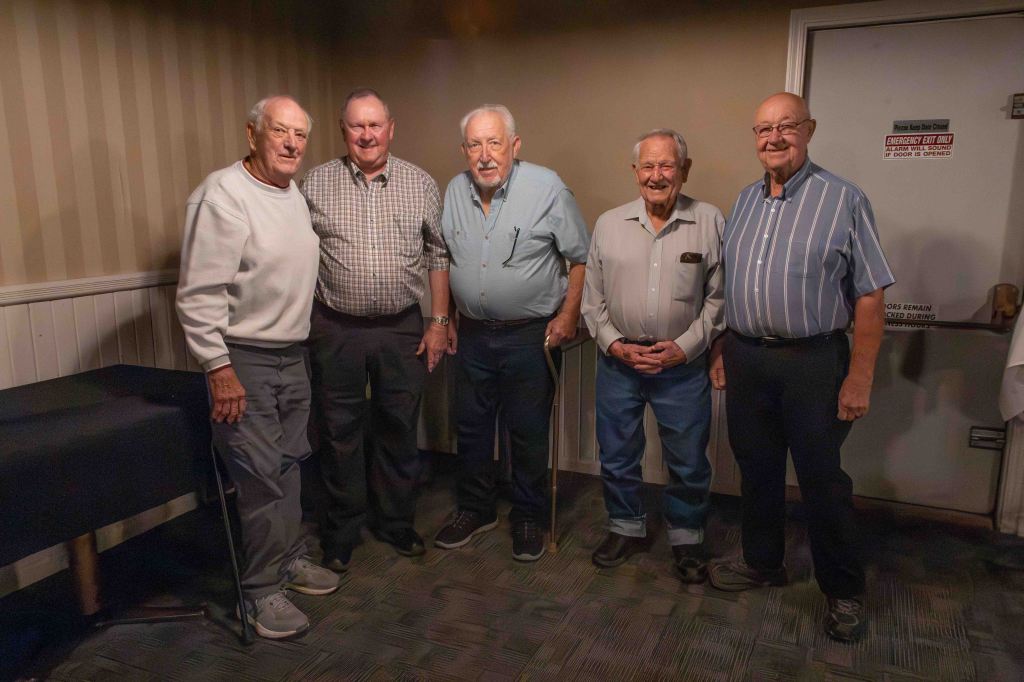
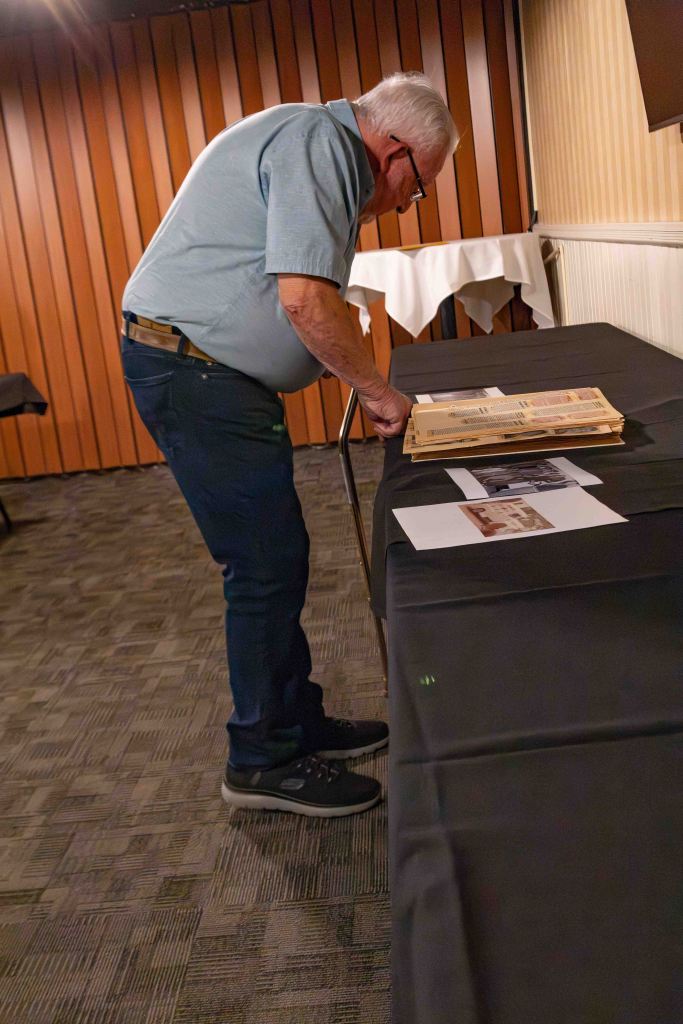
The celebration took place on June 27 at Farmer Brown’s in Waterloo. Original squad members gathered with family and current members & leadership of the Bennington Fire & Rescue crew. While celebrating 60 years of the squads service to Bennington, they reminisced, told stories, and looked through the various scrapbooks that have been kept over the years. These scrapbooks contain photos and news clippings from the beginning of the squad’s formation and beyond.

For Arp, seeing those pioneers reunited, and watching today’s firefighters continue building on what they started, was deeply rewarding.
“We were very dedicated,” he said. “We took any training that we could get a hold of… It was a very good group to work with.”
Nearly 60 years after a handful of volunteers climbed into a refurbished station wagon to answer Bennington’s first rescue calls, their legacy continues every time a firefighter or paramedic responds to someone in need.
“I know that we saved people,” Arp said. “We had people come in and thank us… It was very, very rewarding over the years.”