By Marisa Dawson, courtesy photos
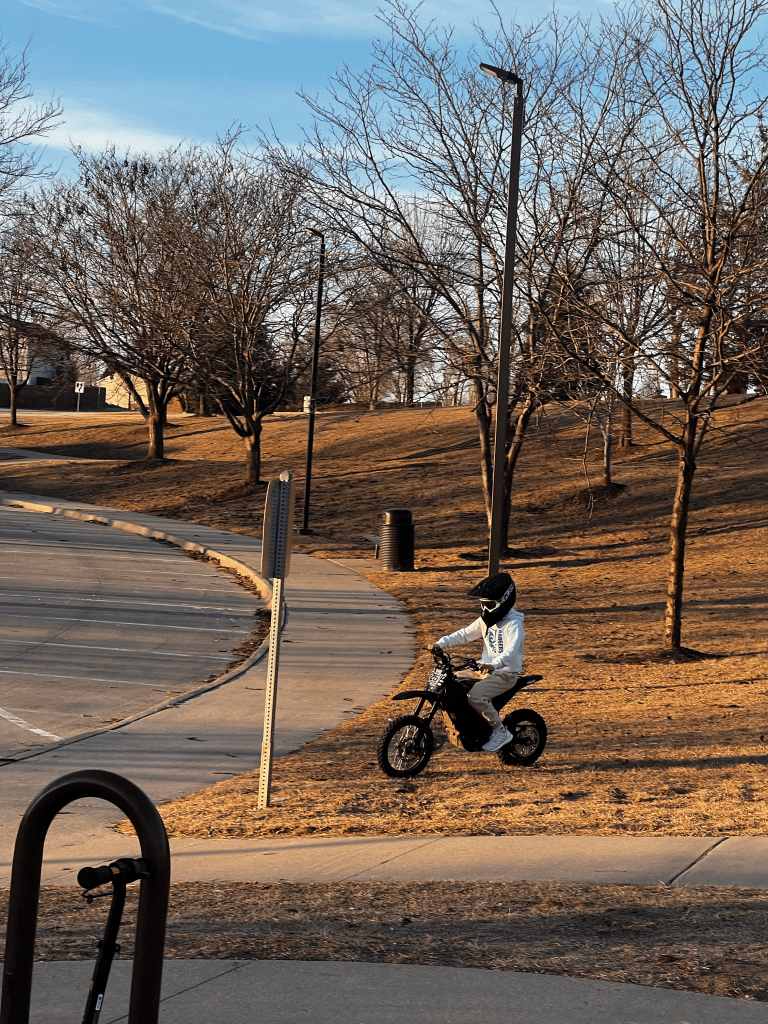
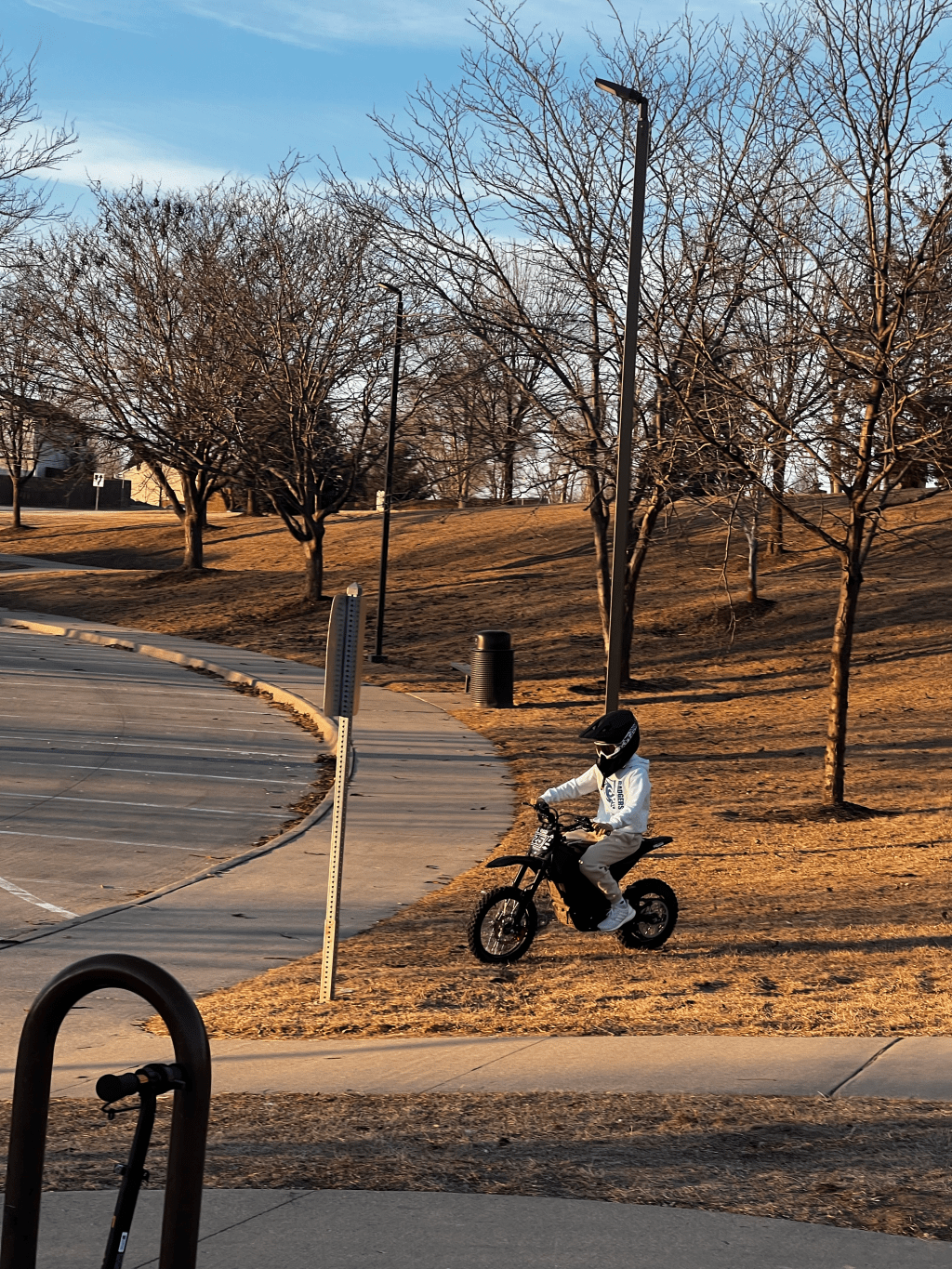
In neighborhoods across Bennington, the whine of electric motors has become a familiar soundtrack as temperatures warm up, as kids on e-bikes, dirt bikes, and scooters zip through streets, sidewalks, and yards at speeds once reserved for cars. Residents are reporting more incidents of reckless riding, with complaints flooding in about children racing down roads, ignoring traffic laws, and carving paths through lawns. It’s a trend echoing nationwide, but here in this growing Omaha suburb, local officials say it’s hitting close to home- and the conversations need to start in living rooms, not just city halls.
Nationally, the rise in e-bikes and similar devices has been explosive. According to the Alternative Fuels Data Center and U.S. Department of Energy data, e-bike sales reached about 1.1 million units in 2022- a four-fold increase from 2019 and a 13.6% rise from 880,000 in 2021. The U.S. e-bike market was valued at $4.06 billion in 2026, with projections to grow.
Bennington Mayor Clint Adams has fielded calls from worried residents, particularly in the older parts of town where sidewalks are spotty. “Just some concerns from residents about kids being in the streets with them and just how fast they go nowadays,” Adams said. “When my kids were playing around on scooters, they were just the good old fashioned use your foot scooters. So I mean, sure, you could get those going pretty good, but you had to work at it. Nowadays, kids are flying, going almost 20 miles an hour, without helmets. And that’s probably one of my bigger concerns and just not paying enough attention to their surroundings and being in the middle of streets versus sidewalks.”
The surge isn’t just anecdotal. Bennington Police Officer Jayme Iversen, who fields many of the calls, described the typical gripes: “In town, it’s just mostly kids going fast and not obeying traffic laws. Kind of in and out of driveways, sidewalks, half on the street. Sometimes those are the big complaints. And then a few of the older residents are like, those kids aren’t wearing helmets.”
Douglas County Sheriff’s Deputy Joseph Martinec has seen the problem spill onto major roads, a shift from the residential focus of years past. “It used to be that we just were getting calls in the residential neighborhoods and now we’re getting calls of these juveniles on what are considered light electric motorcycles out on the major arterial roads,” he said. Hotspots include areas along State, Ida, 168th and 156th Streets, though complaints are creeping farther north. He stated more calls have been coming in reporting juveniles riding on the roads while doing dangerous stunts like wheelies.
This boom has brought rising injuries. According to UC San Francisco and Consumer Product Safety Commission (CPSC) research, e-bike injuries nationally jumped from 751 in 2017 to 23,493 in 2022. E-bike riders are 57% more likely to crash than traditional bike riders. Micromobility-related injuries (including e-scooters, e-bikes, and hoverboards) have trended upward since 2017, increasing an estimated average 23% annually, per CPSC data. Children 14 years and younger accounted for about 36% of these injuries from 2017 to 2022, double their 18% share of the U.S. population.
Assistant Fire Chief Chad Nixon of the Bennington Fire & Rescue has responded to a handful of related accidents, though he noted they’re not yet overwhelming. “I think there has been at least one, if not a couple that we have responded to,” Nixon said. “I’m not sure that they were kid related. I think one was an adult or at least a young adult. So we have seen a couple, but not too many here in this small area.”
While e-bike wrecks might seem like kid stuff, the injuries can rival those from cars or motorcycles, officials warn. Nixon detailed the spectrum: “Obviously we have extremity type injuries- fractures, scrapes and bruises and stuff like that, but it can be more serious than that. If they’re not wearing helmets and you have a head injury or a vehicle involved, there’s obviously injury patterns with multi system trauma when it comes to that.”
Deputy Martinec recalled a tragic case from two years ago: a 60-year-old man on an e-bike hit 28-30 mph downhill in a neighborhood and died after crashing. Now, with “light electric motorcycles” – often mislabeled as e-bikes – capable of 60-70 mph, the stakes are higher. “You can imagine you’re going to have injuries similar to any motorcycle crash on any roadway where everything from broken legs, dismemberment and death,” he said.
Nixon commented on the severity of traditional bike accidents as well: “We’ve had a couple of just bicycle accidents too, where you know, people have been going too fast and wiped out and we’ve had some pretty significant injuries from those too.”
A 2023 study by Laura Goodman et al. in Surgery Open Science (https://www.surgopensci.org/article/S2589-8450(23)00034-9/fulltext) sheds light on the severity. E-bike injuries show an 11.5% hospitalization rate versus 4.8% for traditional bikes. Head trauma increased 49-fold from 2017-2022. The most affected age group was 10–13 years old (44.3% of cases). In reported cases, 97.3% of e-bike riders were without a helmet. Additionally, Rady Children’s Health research notes that the severity of e-bike pediatric orthopedic injuries is comparable to those from motor vehicle accidents.
Motorized versions bring additional unique hazards, especially those with lithium-ion batteries, that parents should pay close attention to. Nixon explained, “It may not be immediately, but if there’s any damage to the battery packs on these, that needs to be taken pretty seriously. If you damage the battery packs, it can put those batteries into a thermal runaway situation, and it may not be immediate. That may take minutes to hours before you realize that. And that’s by that time it’s back in your garage or it’s back in your house plugged in and charging.”
Consumer Product Safety Commission (CPSC) data further highlights fire risks: The agency noted 19 deaths associated specifically with micromobility device fires from January 1, 2021, through November 28, 2022. In December 2022, the CPSC urged over 2,000 manufacturers, importers, distributors, and retailers of e-scooters, self-balancing scooters, e-bicycles, and e-unicycles to ensure compliance with voluntary safety standards to reduce fire risks, or face enforcement. CPSC advises consumers to use only certified products, supervise charging (never while sleeping), use the supplied charger, and approved replacement batteries.
Enforcement is a minefield, officials agree. Officer Iversen outlined the e-bike classes and noted how enforcement can be difficult in many situations. “Unfortunately, legislation doesn’t keep up. I mean, they’re two years behind at times. So when something new comes out, they just throw it out there and it’s just a test trial. You know, everybody’s the guinea pig, and legislators need time to catch up.”
Bennington and Douglas County have no specific ordinances for these vehicles; they’re treated like bicycles. Helmets are “encouraged,” not required. “There are no ordinances. It’s just like a bicycle,” Iversen said. However, Deputy Martinec added, “If they’re operating on the road, they do have to obey every motor vehicle law, just like a bicyclist does when they’re riding on the road.”
Deputy Martinec drew a sharp line between true e-bikes – which have pedals and assist up to certain speeds – and “light electric motorcycles,” often sold to kids marketed as toys. “E-bikes are defined under state law and there’s three classes… But every e-bike has pedals that can actually power the bike under human power alone. And they’re electric assisted.” The latter? “They are electric motorcycles… so they require you to be 16 years of age, have a valid driver’s license with either a motorcycle license or motorcycle endorsement. And you have to follow all the motor vehicle laws as well as the safety equipment of helmets and everything else.”
Parents often don’t know the difference, Martinec added: “When we’ve made contact with the parents before, they thought that what they had purchased for their child was an e-bike. And we have to explain to them that it’s not actually an e-bike, it’s an electric motorcycle.” He further explained that when minors are stopped for disobeying traffic laws on bikes and other small motorized vehicles, they attempt to locate and contact parents. With continuing issues, parents could face consequences as well. “We’ve been telling the parents, if you continue to allow your child to violate the law by allowing him to ride this light electric motorcycle, you yourself can be arrested for contributing to delinquency of a minor,” he said.
Fleeing suspects on trails complicates pursuits. “A lot of times when we get there, the people have already moved on, we can’t locate them. On the occasions where we’re there and we do actually see them, we do try to initiate contact. A lot of times, however, the people flee on those bikes and they’ll go off road onto the trail systems that are around the area and it’s dangerous for us to chase them at that point.”
With laws trailing tech, all four officials pointed to homes as the first line of defense. “The majority of it needs to start at home with parents being responsible, making sure the kids are being responsible and smart with it,” Mayor Adams said. “I just want to make sure parents are aware of what their kids are doing and have talks with them to make sure that they’re staying out of the streets where possible. If they are in the streets, slow it down and do the good old fashioned ‘look left and look right’ before you do anything. If you are going to make the investment of these faster e-bikes and scooters, they really should be wearing helmets. I know it may not be ‘cool,’ but it’s not worth something bad happening to your kid.”
Assistant Fire Chief Nixon urged due diligence on purchases. “Make sure that you do some research on them. If it’s a rechargeable scooter or bike or whatever it is, do some research. Make sure you’re buying quality products. Cheaper is not always better. Do a little bit of the background on the testing procedures and stuff for American made lithium ion batteries compared to maybe something that comes from a foreign country.”
Something everyone agreed on is that protective gear should be non-negotiable. “Make sure that whoever’s riding is wearing proper protective equipment- at a minimum a helmet. And that could also be elbow pads and knee pads, just to help with some of those musculoskeletal injuries… The other thing is something reflective. Make sure that it’s visible even in the daylight,” Nixon added.
Deputy Martinec also stressed helmets, saying, “Wear safety equipment, even if you’re riding a bicycle, wear a bike helmet. If you’re riding an e-bike or a light electric motorcycle, you probably need to look at having an actual motorcycle helmet, just because of the speeds that are involved… Obey all traffic laws, because if a kid runs a stop sign on a scooter or a bike or an electric bike and gets hit by a car, it’s going to be the kid’s fault.”
Officer Iversen echoed the call for respect. “There are people walking on the road- the bike’s going to hurt somebody. If you’re going too fast, slow down, use your helmet. I get you want to show off to your friends, but there’s a time and place for that on the street and on the sidewalks are not for those.” He noted that proper education for kids riding is essential to reduce the risk of accidents. “They have their own phone problems in school- they have to put their phone away… Other drivers aren’t always on top of it,” he added. “They might not see you because you’re so small… Double look both ways again, back to the old school stuff.”
Outreach is on the radar. The fire department eyes its June open house and other public education events throughout the year as education opportunities, possibly partnering with groups like Children’s Nebraska.
Police and sheriff’s offices plan social media pushes and talks as riding season ramps up. “We’ll continue our enforcement efforts. And typically, we try to make our first encounter with these people an educational encounter,” Martinec said. Iversen suggested joint efforts: “It would be something where we should pair up together. It’s merely for safety.”
Mayor Adams sees potential for city rules, like helmet mandates in other towns. “I believe I’ve heard that some other municipalities have been looking at or passing ordinances where if they’re going to do it, they have to wear helmets. I don’t know if we’re there yet or if that’s something we may consider.”
For now, the message is clear: Parents, know what you’re buying, and talk to your kids. As Iversen put it, “The big thing is the calls, when we get it is on helmets. Yes, it should be mandatory, but it is not. … Parents need to do their research when they go to buy what they think is a toy and understand that there’s a possibility they’re actually buying their kid a motor vehicle and not just a toy.”
In a world where fun meets firepower, vigilance starts at home.