By Marisa Dawson, with the assistance of Bennington Historical Society files
The arrival of electricity in our community marked a transformative chapter in its early 20th-century life, bringing light, convenience, and progress to a community of roughly 300 residents situated about 16 miles northwest of Omaha.
In 1911, local garage owner John F. Peterson found himself without any public electric service available. Determined to power his business, he installed a substantial farm-style electric light plant. This setup quickly proved its value, and soon neighbors and nearby shopkeepers expressed keen interest. Peterson responded by acquiring a second generating unit, extending service beyond his garage to a handful of local stores.
Word spread rapidly, and enthusiasm for electric lighting surged among Bennington’s residents and business owners. Before long, Peterson’s modest plants reached full capacity. Community leaders urged him to expand further to supply the entire village. In 1915, he upgraded the system with a 25-horsepower gas engine driving a 12.5-kilowatt generator. This improvement handled nighttime needs effectively, but daytime demand remained too low to justify running the equipment around the clock, making daytime operations unprofitable.
To address the issue and provide reliable daytime power, Peterson added a large storage battery system. Local businessmen supported the expansion by helping finance the new equipment, with the understanding that Peterson would repay them from future revenues as the operation grew.
Customers enjoyed straightforward rates: a flat $1.00 monthly charge covered the first 5 kilowatt-hours, with an additional 12 cents per kilowatt-hour for any excess usage. The homegrown utility operated successfully until late 1917, when the Platte Valley Power Company acquired it. The sale included $500 worth of stock in the larger firm plus a business lot in Bennington.
Under Platte Valley Power Company ownership, the local plant continued serving the area until spring 1919. At that point, a new transmission line connected Bennington to Irvington, allowing the company to purchase electricity from the Nebraska Power Company (with metering at Irvington). This shift brought more stable supply and aligned Bennington’s rates with those in nearby towns like Waterloo, Elkhorn, and Valley.
The network expanded steadily. The Irvington-to-Bennington line later stretched westward to link with existing lines serving Elkhorn, Waterloo, and Valley, tying into a generating facility there. By 1922, construction began on another transmission line running from Bennington through Washington, Kennard, and onward to Herman. Energized on January 25, 1923, it brought electricity to Washington, where the village built its own distribution system that year.
Platte Valley Power Company remained the provider for Bennington, Washington, Kennard, and Herman until September 1927, when the Nebraska Power Company purchased the entire system, integrating it into a broader regional network.
Longtime residents later shared vivid memories of the early independent plant’s quirky routine. The generator wasn’t kept running through the night. About 15 minutes before shutdown, the operator deliberately reduced power, causing lights across town to dim noticeably. This served as a gentle signal, giving households time to strike matches and light kerosene lanterns before darkness fell completely.
From a single garage owner’s initiative to connections with larger regional utilities, Bennington’s journey to electrification reflected the ingenuity, community cooperation, and gradual modernization that shaped many small Nebraska towns in the early 1900s.
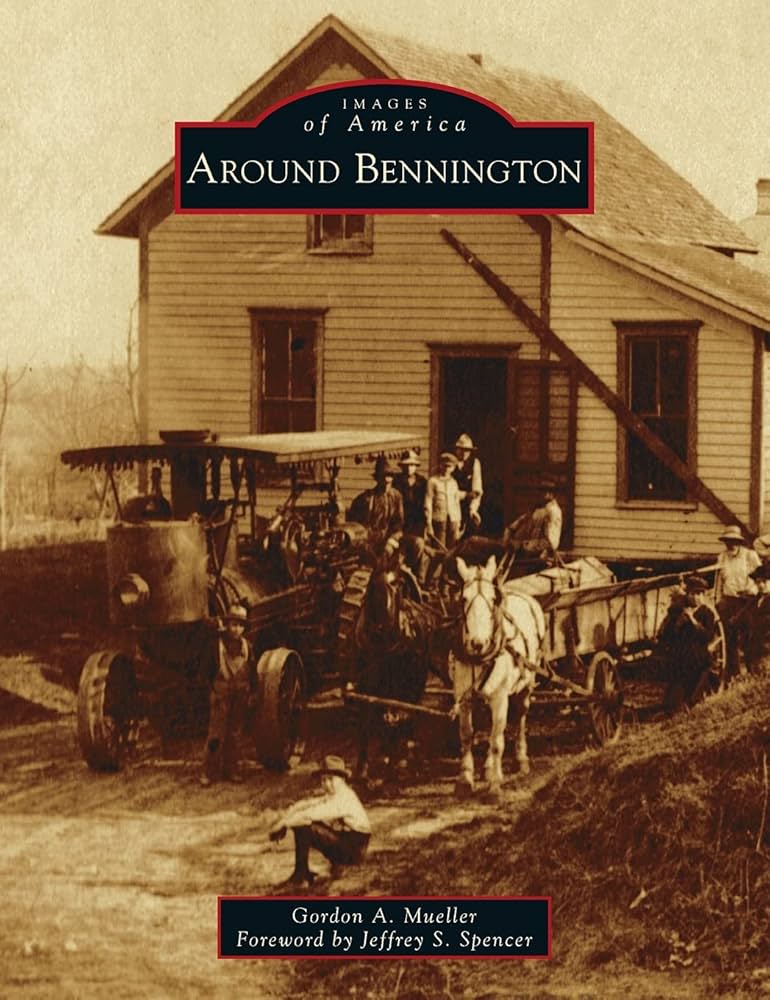
For those interested in learning more about Bennington’s rich history, keep following along for history articles and check out Gordon Mueller’s book, Images of America: Around Bennington.