By Marisa Dawson
In the rolling fields of Nebraska, at the intersection of 152nd and Military Road, stands a monument to agricultural ambition: the Ackerhurst-Eipperhurst Dairy Barn. This architectural marvel, born from the vision of Boston dairyman Anthony W. Ackermann, broke ground in March 1935 and swiftly rose to become a cornerstone of Nebraska’s dairy industry.
Under the skilled hands of local builder Adolph Otte from Elkhorn, Nebraska, a crew of eight to ten men toiled tirelessly, working ten-hour days, seven days a week. Some even camped on-site in tents to protect the precious lumber, ensuring the barn’s completion by July 4, 1935—an astonishing five-month feat for a structure of its grandeur. Dubbed the largest barn in Nebraska upon its unveiling, the Omaha World Herald in 1935 hailed it as “one of the finest dairy farms in the middle west.”
The barn, a stunning example of Dutch Gambrel architecture, was designed with purpose. Its long axis housed milking stanchions along the outer walls, while a central aisle provided easy access to the herd. Large windows, a hallmark of Dutch Colonial Revival style, flooded the barn with light and air, essential for the demanding thrice-daily milking schedule at 7 am, 3 pm, and 11 pm. The towering gambrel roof, with its intricate, near-Gothic truss system, created a vast haymow that could be filled three times annually with premium hay, trucked in to feed the barn’s 100 purebred Holstein cows.
Ackermann’s commitment to quality was unparalleled. A veterinarian was always on-site, milking equipment was crafted from cutting-edge stainless steel, and attendants donned fresh uniforms for each barn entry, undergoing monthly health checks to ensure purity. Milk was processed in an adjacent pasteurizing house, chilled electronically, and rigorously tested for butterfat content. The herd’s excellence earned frequent accolades from the Nebraska Dairymen’s Association, with the Holsteins setting a world record in the 1930s for an annual average of 538 pounds of butterfat per cow.
In 1942, Ackermann sold the dairy to Robert Anderson, who renamed it Anderhurst Dairy. By 1948, Fred Eipperle Sr. took ownership, christening it Eipperhurst Farm and Dairy. The Eipperle family continued the barn’s legacy of excellence, with Fred Eipperle Jr. taking the reins in 1962. That same year, their Holstein, Abarland Insignia Bobelle, set a state record by producing over 13 tons of milk with 1,161 pounds of butterfat.
The barn’s journey continued through changing hands. In 1995, Welchert Construction Company acquired the property, followed by The Barn, Inc., in 1999. Today, part of the barn serves as office space, while the rest has been transformed into a vibrant event center, preserving its historic charm.
The Ackerhurst-Eipperhurst Dairy Barn emerged during a pivotal moment in Nebraska’s dairy industry. Before 1930, only five cooperative creameries operated in the state, but by the decade’s end, that number had surged to 52, reflecting a growing commercial dairy market. Post-World War I innovations in farming and architecture inspired Ackermann’s bold venture. The barn’s Dutch Gambrel design, with its shed dormers and expansive hay storage, perfectly suited the demands of large-scale dairy production, cementing its status as a “classic” dairy barn.
Today, this historic structure stands as a reminder of Nebraska’s agricultural heritage, blending functionality with architectural elegance. Its story is one of innovation, dedication and a relentless pursuit of excellence- a legacy that continues to inspire.
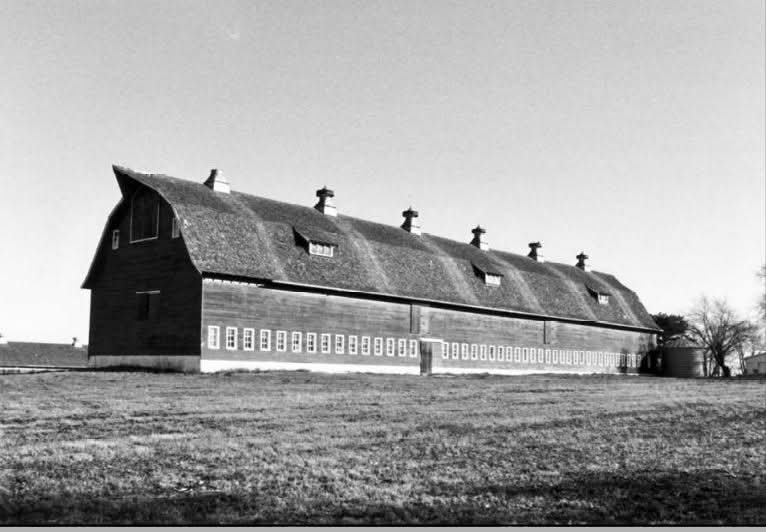
*Photo and info courtesy of Elkhorn Historical Society