By Marisa Dawson
In July, the Bennington Fire Department conducted an in-depth water and boat training exercise on a local lake, focusing on search and recovery operations. The drill involved a simulated scenario where a mannequin was placed in the lake, and the crew was tasked with locating it using their boat equipped with advanced sonar technology. The exercise aimed to enhance the team’s proficiency in both launching and operating the boat and interpreting sonar data, critical skills for effective water rescue and recovery missions.
Assistant Chief Chad Nixon, who oversaw the training, emphasized the importance of such exercises in building the team’s capabilities. “This is probably the most organized we’ve had,” Nixon said. “We try to get out once or twice during the boating season to do this. The goal of today’s training is for people who haven’t had a lot of time either running the boat, driving the boat, or being the sonar person to get out of the station, get here, locate a reporting party and then start some kind of organized search.”
The training focused on familiarizing the crew with the boat’s sonar system, which is used to scan the lakebed. “The sonar probes are on each side of the jet siphon, so they’re basically getting a side view on each side of the boat as we go past,” Nixon said. Captain Jordan Smith, who led the on-water demonstration from the boat, explained how the sonar technology works in more detail. He demonstrated how the sonar screen displays potential objects, noting the difference between large debris, such as logs or trees, and smaller objects that could indicate a person. By scanning the lake in multiple directions, the crew can create a clearer picture of potential targets, marking waypoints electronically for further investigation.
Nixon highlighted the practical challenges of sonar interpretation. “What the sonar does is it’s casting a shadow,” he explained. “They’ll measure it to be like, ‘That’s 10 feet long, that cannot be a human,’ or ‘That matches the parameters of less than six feet.’ So they can mark that and come back across it the other way, and maybe it will cast a different shadow, and they’re confident that that’s the mark.”
The department’s boat is equipped with tools to measure objects on the sonar screen. “There are tools on the sonar,” Nixon said. “You can put a little pin and another little pin and then measure the distance between.” If the crew identifies a promising target, they can deploy a weighted buoy or a large dog kennel to mark the location within five feet, ensuring divers can efficiently investigate the site. “We want to try to drop as close to within five feet of the mark as we can, and then have a buoy that comes up to it,” Nixon mentioned.
The training also covered basic boat operations, such as launching and docking, which are important both for safety and efficiency. “A lot of this is just getting out and doing it,” Nixon said. “Some of it is as basic as being able to back a boat in and how you get the boat on and off the trailer. There’s specific nuances, like with an inboard motor, you have to lift the lid and start a blower fan just so that there’s no safety issues.”
The department’s water rescue capabilities have improved significantly since acquiring a better-equipped boat and sonar system. Nixon noted an increase in calls for water rescue and recovery operations. “It has been increasing, just because we have a better boat and a better sonar, and we’ve been successful on the river and at Lake Cunningham,” he said. “Word of mouth travels, right? When you do a good job, people are like, ‘Well, get Bennington out here.’”
While the department requires all members to complete an annual boater safety class, Nixon explained that there are no formal certifications for sonar operation. He further noted that Captain Jordan Smith has attended sonar classes and has taught the basics to other members of the crew. The department aims to build on these skills, with plans to incorporate swim tests and in-water training in the future. “The program will hopefully advance over time so that if we do need to get in the water, we’re better at that,” Nixon said. For recovery operations requiring divers, Bennington collaborates with Omaha Fire’s dive team, as maintaining a dedicated dive team is resource-intensive.
The training also prepares the crew for the environmental challenges of Nebraska’s waters. “Eight months out of the year, Nebraska water is considered a cold water environment because it’s less than 72°F,” Nixon said. To protect against cold temperatures and waterborne contaminants like algae or E. coli, the crew uses dry suits. For water rescue calls, the crew arrives ready to go, similar to how they would arrive prepared for a call regarding a fire.
Reflecting on a past incident at Bennington Lake in 2021, Nixon underscored the importance of readiness. “They were tubing and spun around too fast and hit the seawall, and there were three people in the water, two of them kids,” he recalled. “Our guys jumped in the water and got them out. That was before we had any of this stuff. Not ideal, but you do what you have to.”
The Bennington Fire Department’s commitment to ongoing training ensures they are better prepared to respond to water emergencies, providing critical support to the community and closure for families in recovery situations.
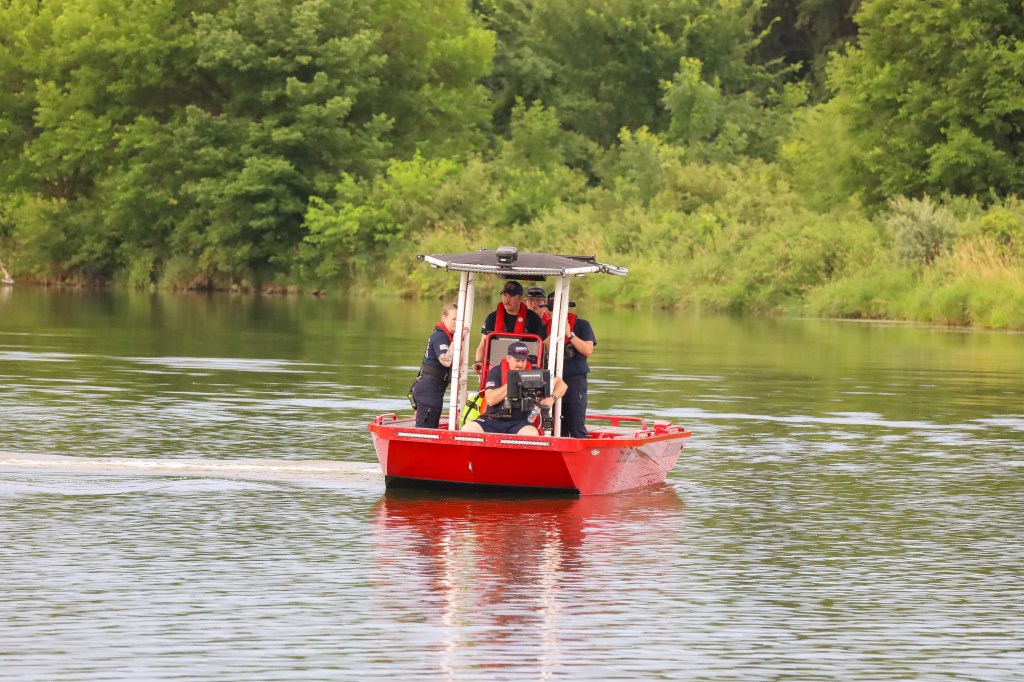
From left to right: Jessica Gerber, Riley Snoderly (driving), Captain Jordan Smith, and Jake Needham navigate the water while Brad Utterback (front) scans the sonar screen.
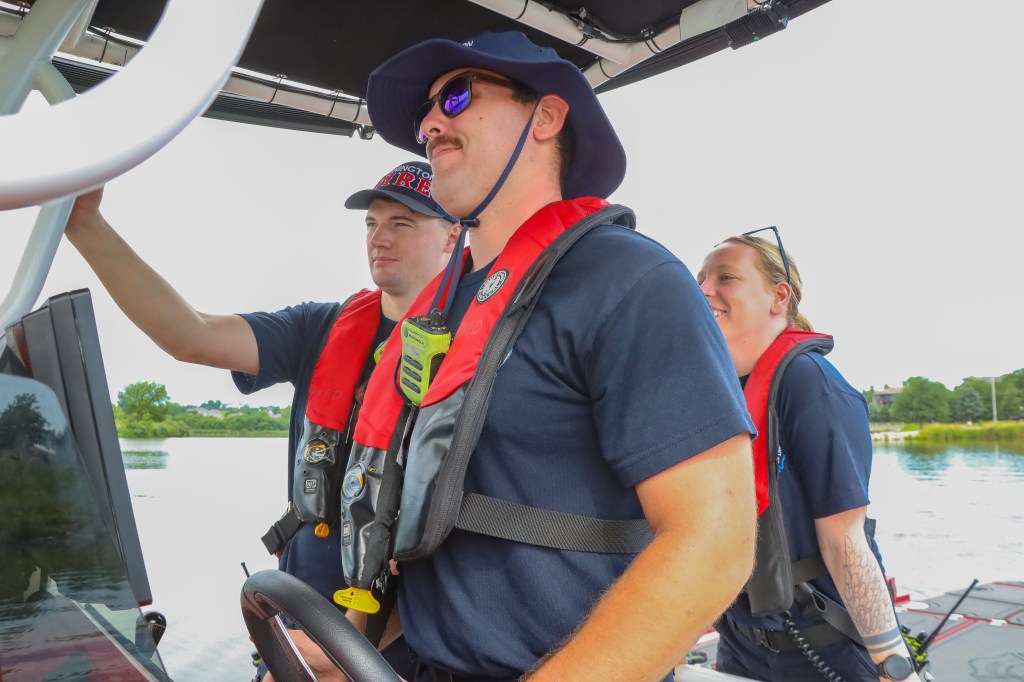
From left to right: Eric Shockley, Jake Needham, and Jessica Gerber navigate the boat in a grid pattern across the lake.

The sonar screen depicts what rescuers look for during recovery efforts. Using guides at the top and sides of the screen, they can estimate the approximate size of anything appearing on the screen to determine whether it may be what they are looking for.
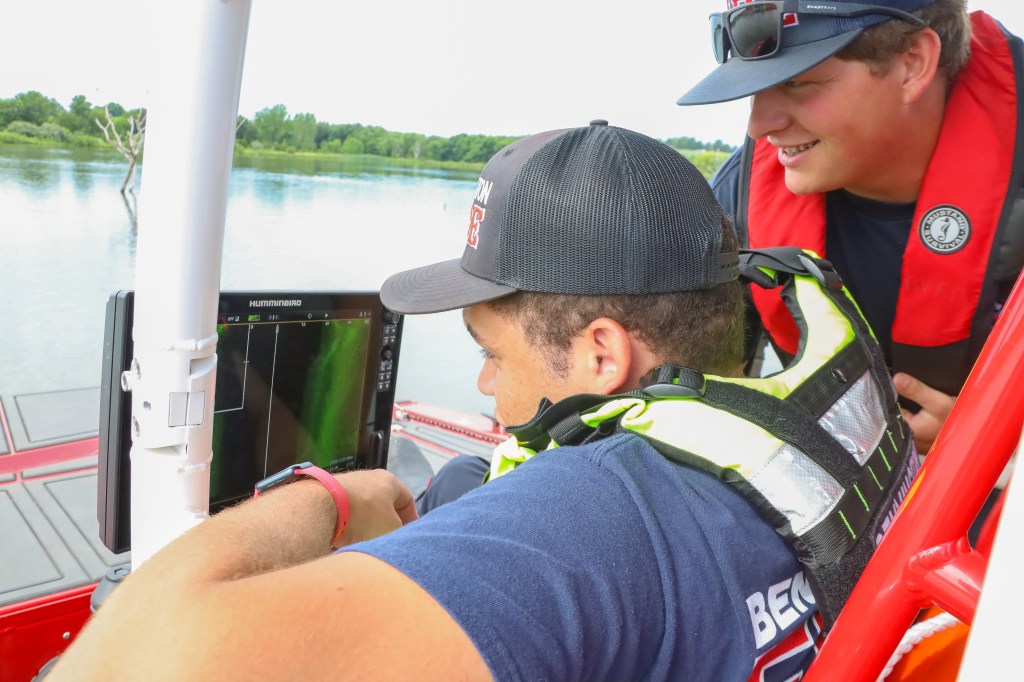
Captain Jordan Smith (right) talks to Kaden Ross (left) about what to look for on the sonar screen.
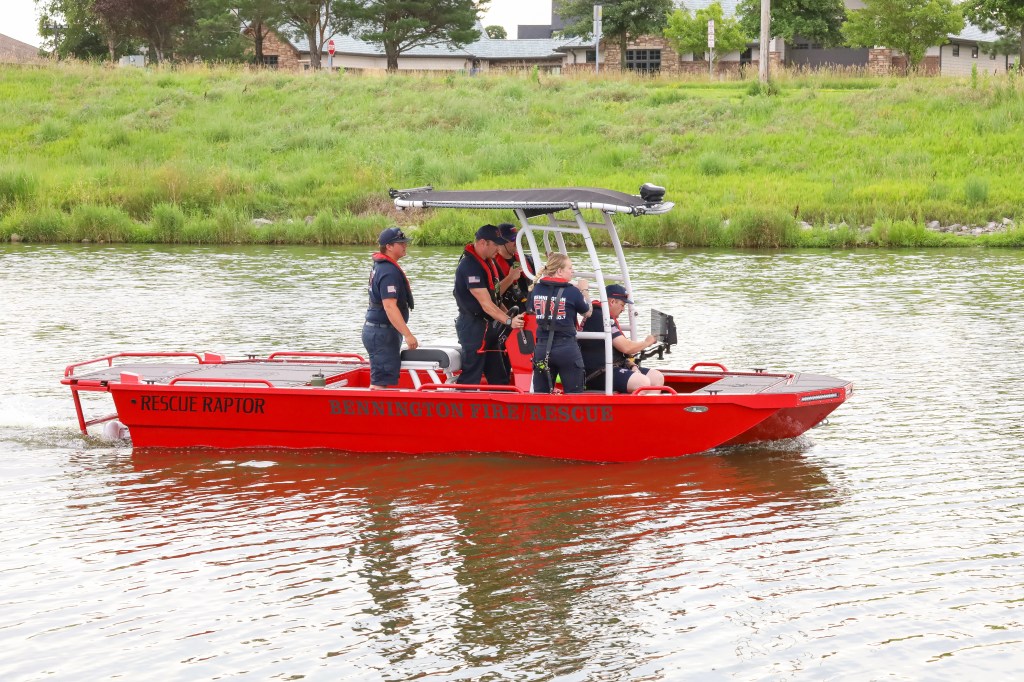
From left to right: Captain Jordan Smith, Riley Snoderly (driving), Jake Needham, Jessica Gerber, and Brad Utterback (on sonar).
*All photos by Marisa Dawson